导数与微分#
一元微分的定义与构成#
$$ \Delta y=f'(x_0)\Delta x+\circ(\Delta x)\\ 线性主部:f'(x_0)\Delta x $$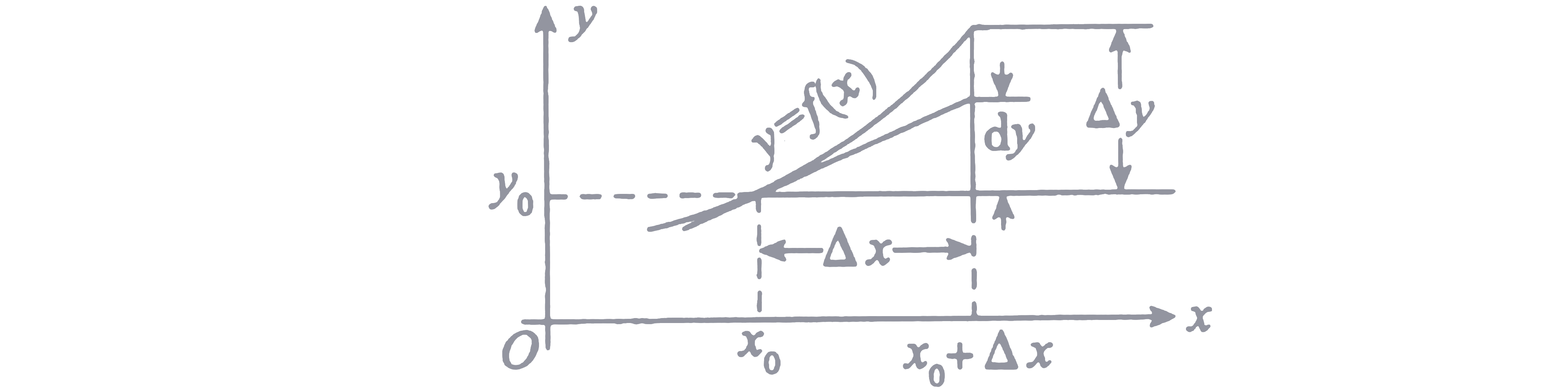
导数与极限关系#
$$ x\to 0时,\frac{f(x)-f(a)}{x-a}\rightarrow A,则称f'(a)=A,\\即\frac{f(x)-f(a)}{x-a}\rightarrow f'(a)\\ $$$$ 例: \lim\limits_{x\to a}\frac{\frac{f(x)-f(a)}{x-a}-f'(a)}{x-a}\neq \lim\limits_{x\to a}\frac{f'(a)-f'(a)}{x-a} $$重要结论#
$$ 有切线不一定有导数\\ y=x^{\frac{1}{3}}在x=0处有切线,但导数无穷大 $$ $$ 高阶可导,低阶一定可导 $$定义求导的三要素#
$$ 1. 增量对应\\ \lim\limits_{x\to 0}\frac{f(1+x)-f(1)}{x}\Leftrightarrow \lim\limits_{x\to 1}\frac{f(x)-f(1)}{x-1}\\ 2. 一动一静(定点性)\\ 3. 双侧性(增量有正有负) $$$$ 双动点导数:\\ \lim\limits_{x\to 0}\frac{f(a+x)-f(a)}{x}\exists=f'(a)\substack{\Rightarrow\\ \not\Leftarrow}\lim\limits_{x\to 0}\frac{f(a+\Delta_1)-f(a+\Delta_2)}{\Delta_1-\Delta_2}=f'(a)\\\left( \lim\limits_{\Delta_i\to 0}\left[\Delta_1\frac{f(a+\Delta_1)-f(a)}{\Delta_1}-\Delta_2\frac{f(a+\Delta_2)-f(a)}{\Delta_2}\right]\frac{1}{(\Delta_1-\Delta_2)}=f'(a)\right) $$导数存在充要判据#
$$ 直接判断:左导=右导\\ 前提:函数连续,左、右导数存在(若不满足,直接不可导) $$导函数的奇偶性、周期性#
$$ 各阶可导的前提下:\\ \ \\ f(x) 偶 \Rightarrow f'(x) 奇\\ \ \\ g(x) 奇 \Rightarrow g'(x) 偶\\ \ \\ f(x) 偶 \Rightarrow f'(x) 奇 \Rightarrow f''(x) 偶 ......\\ \ \\ f(x) T \Rightarrow f'(x) T \Rightarrow f''(x) T \Rightarrow.... $$可导,左导、右导与连续的关系#
用图像记忆
$$ 左导 \Rightarrow 左连续,右导 \Rightarrow 右连续\\ \ \\ 左导、右导 \Rightarrow 连续(无需左导等于右导)\\ \ \\ 可导 \Rightarrow 连续 $$左导右导、导函数的左右极限关系#
$$ \lim\limits_{x\to x_0^+}\frac{f(x)-f(x_0)}{x-x_0}\neq \lim\limits_{\begin{array}{l}x\to x_1^+ \\x_1\to x_0^+ \end{array}}\frac{f(x)-f(x_1)}{x-x_1} $$$$ 注:导数与导函数极限相互独立,互不影响 $$$f(x_0)$ 可导与$|f(x_0)|$ 可导的关系#
$$ f(x)在x_0处可导,则 $$$$ \left\{ \begin{array}{l} f(x_0)\neq 0时,y=|f(x)|在x_0处可导\\ \\ f(x_0)= 0\ 且f'(x_0)\neq0时,y=|f(x)|在x_0处不可导\\ \\ f(x_0)= 0\ 且f'(x_0)=0时,y=|f(x)|在x_0处可导(y'|_{x_0}=0)\\ \end{array} \right. $$含高阶无穷小求导数问题#
$$ g(x)=2x+3x^2+x^3+\underbrace{\circ(x^3)}_{f(x)},求g^{(k)}(0) $$泰勒公式法直接对应即可
$$ 结论:f(x)\ 在x=0处n阶可导,f(x)=\circ{(x^n)}(即\lim\limits_{x\to0}\frac{f(x)}{x^n}=0), 则\\ \left\{\begin{array}{l} f^{(k)}(0)=0,k=1,2,\cdots,n\\ g^{(k)}(0)=a_k\cdot k!,k=1,2,\cdots,n\\ \end{array}\right. $$$$ 注:f(x)\sim ax^k \Leftrightarrow f(x)=ax^k+\circ(x^k) $$$$ {\color{grey}证f(x)在x=0处的低阶导数,构造低阶即可} $$$$ {\color{grey}x=0处f(x)n阶可导,则\exists \ x=0的某邻域,使f(x)\ n-1阶可导} $$$$ {\color{grey}\begin{array}{rl} &\lim\limits_{x\to 0}\frac{f(x)}{x^{n-1}}=0\\ \underrightarrow{n-1次洛必达}&\lim\limits_{x\to0}\frac{f^{(n-1)}(x)}{(n-1)!}\ \exists\\ \therefore & \lim\limits_{x\to0}\frac{f^{(n-1)}(x)}{(n-1)!}=\lim\limits_{x\to 0}\frac{f(x)}{x^{n-1}}=0,即\lim\limits_{x\to 0}f^{(n-1)}(x)=0\\ \because & f(x)\ n阶可导\\ \therefore & f^{(n-1)}(0)=0\\ \\ &\lim\limits_{x\to 0}\frac{f(x)}{x^n}=0\\ \underrightarrow{n-1次洛必达} & \lim\limits_{x\to 0}\frac{f^{(n-1)}(x)}{(n-1)!x}=\frac{1}{(n-1)!}\lim\limits_{x\to0}\frac{f^{(n-1)}(x)-f^{(n-1)}(0)}{x-0}=\frac{1}{(n-1)!}f^{(n)}(0)\ \exists\\ \therefore & \frac{1}{(n-1)!}f^{(n)}(0)=\lim\limits_{x\to 0}\frac{f(x)}{x^n}=0 \end{array}} $$导数求泰勒展开式问题#
$$ f^{(k)}(x_0)=a_i,i,k=1,2,\cdots,f(x)=\sum_{i=1}^n a_i(x-x_0)^i,i=1,2,\cdots $$ $$ f^{(k)}(x_0)存在,低阶导均为0,则f(x)\sim \frac{f^{(k)}(x_0)}{k!}x^k\\ 即f^{(k)}(x_0)存在,且低阶导均为0,则f(x)\sim ax^k\Leftrightarrow f^{(k)}(x_0)=ak! $$高阶无穷小求导函数#
$$ \not\Leftrightarrow 幂函数求导函数 $$ $$ f(x)=x^{20}\sin\frac{1}{x} $$$$ \left\{ \begin{array}{l} f(x)\sim\circ(x^{19})\\ f^{(9)}(x)\sim\circ{(x)}\\ \end{array} \right. $$$$ g(x)=x^{20}\sin\frac{1}{x^5} $$……
幂函数在原点的可导性讨论#
$$ y=x^u $$$$ \left\{ \begin{array}{ll} u\geqslant1,& 原点处一定可导\\ 0< u<1,&原点一定不可导\\ u<0,&原点处无定义 \end{array} \right. \\ \lim\limits_{x\to 0}\frac{x^k-0}{x-0}=\lim\limits_{x\to 0}x^{k-1}(0<k<1)\ \nexists $$基本导数公式#
$$ (x^ u)', (a^ x)',(e^ x)', (\sin x)',(\cos x)', (\tan x)', (\cot x)', (\sec x)', (\csc x)', \\ (\log_a x)', (\ln x)', (\arcsin x)', (\arccos x)', (\arctan x)',(\mathrm{arccot} x)', [\ln(\sqrt{x^2+a^2}+x)]',[\ln|\sqrt{x^2-a^2}+x|]' $$ $$ \begin{array}{ll} (x^ u)'=u x^{u-1}(u=C)\\ \\ (a^ x)'=\ln a \ a^ x (a>0 且 a \neq1) & (e^ x)=e^ x \\ \\ (\sin x)'=\cos x & (\cos x)'=-\sin x \\ \\ (\tan x)'=\sec^2x & (\cot x)'=-\csc^2x \\ \\ (\sec x)'=\sec x \tan x & (\csc x)'=-\csc x \cot x \\ \\ (\log_ax)'=\frac{1}{x\ln a} (a>0 且 a\neq 1) & (\ln x)'=\frac{1}{x} \\ \\ (\arcsin x)'=\frac{1}{\sqrt{1-x^2}} & (\arccos x)'=-\frac{1}{\sqrt{1-x^2}} \\ \\ (\arctan x)'=\frac{1}{1+x^2} & (arccot x)'=-\frac{1}{1+x^2} \\ \\ [\ln(\sqrt{x^2+a^2}+x)]'=\frac{1}{\sqrt{x^2+a^2}} & [\ln|\sqrt{x^2-a^2}+x|]'=\frac{1}{\sqrt{x^2-a^2}} \end{array} $$常见的高阶导数公式#
$$ e^x, a^x, \sin x,\cos x, x^a, \frac{1}{x},\ln x $$ $$ \begin{array}{ll} (e^x)^{(n)}=e^x, & (a^x)^{(n)}=a^x\cdot \ln^n a, \\ \\ (\sin x)^{(n)}=\sin(x+\frac{n\pi}{2}), & (\cos x)^{(n)}=\cos(x+\frac{n\pi}{2}), \\ \\ (x^a)^{(n)}=a(a-1)(a-2)\cdots(a-(n-1))x^{a-n}, \\ \\ (\frac{1}{x})^{(n)}=(-1)^{n}\ n! \ x^{-(n+1)},\\ \\ (\ln x)^{n}=(-1)^{n-1}(n-1)!\ x^{-n} \end{array} $$复合函数求导#
$$ 一阶导:\{f[g(x)]\}'=f'[g(x)]\cdot g'(x) $$$$ 高阶导:\{f[g(x)]\}^{(n)}\neq f^{(n)}[g(x)]\cdot g^{(n)}(x) $$幂指函数求导#
$$ y=u(x)^{v(x)} $$ $$ 指数化:y=e^{v\ln u} $$$$ 对数化:\ln y=v\ln u(定义域变小,函数对应关系不变) $$反函数求导#
一阶 y=f(x)可导,且f’(x)≠0; 二阶 y=f(x)二阶可导,且f’(x)≠0
注意因、自变量对应
$$ 一阶导:\varphi'(y)=\frac{1}{f'(x)} $$$$ 二阶导:\varphi''(y)=-\frac{f''(x)}{[f'(x)]^3} $$隐函数求导#
(两种方法,灵活选择)
特点:导函数会“耦合”自变量、因变量
$$ 隐函数存在定理(一阶导简便)\\ F(x,y)=0,\ \frac{dy}{dx}=-\frac{F'_x}{F'_y} $$$$ 方程两边同时自变量求导\\ (某点的导数,不必整理,代入简便) $$$$ 技巧:利用原方程化简\quad xe^{f(y)}=e^y,求\frac{d^2y}{dx^2}\\ $$参数方程求导#
$$ 一阶导:\frac{dy}{dx}=\frac{y'(t)}{x'(t)} $$$$ 二阶导(高阶导与二阶导同理):\\ \frac{d^2y}{dx^2}=\frac{d[\frac{y'(t)}{x'(t)}]/dt}{\frac{dx}{dt}}=\frac{y''(t)x'(t)-y'(t)x''(t)}{[x'(t)]^3} (用第一步公式简单) $$$$ 注:一阶导(x(t),y(t)均可导,且x'(t)≠0)\\ 二阶导(x(t),y(t)均二阶可导,且x'(t)≠0) $$高阶求导公式(u,v,w 均n阶可导)#
$$ (u\pm v)^{(n)}=u^{(n)}\pm v^{(n)} $$$$ (uv)^{(n)}=\sum_{k=0}^nC^k_nu^{(n-k)v^{(k)}} $$$$ (uvw)'=u'vw+uv'w+uvw' $$切线方程与法线方程#
$$ 切线方程:y-f(x_0)=f'(x_0)(x-x_0) $$$$ 法线方程:y-f(x_0)=-\frac{1}{f'(x_0)}(x-x_0) $$已知可导反求参数(两步走)#
- 连续
- 左导=右导